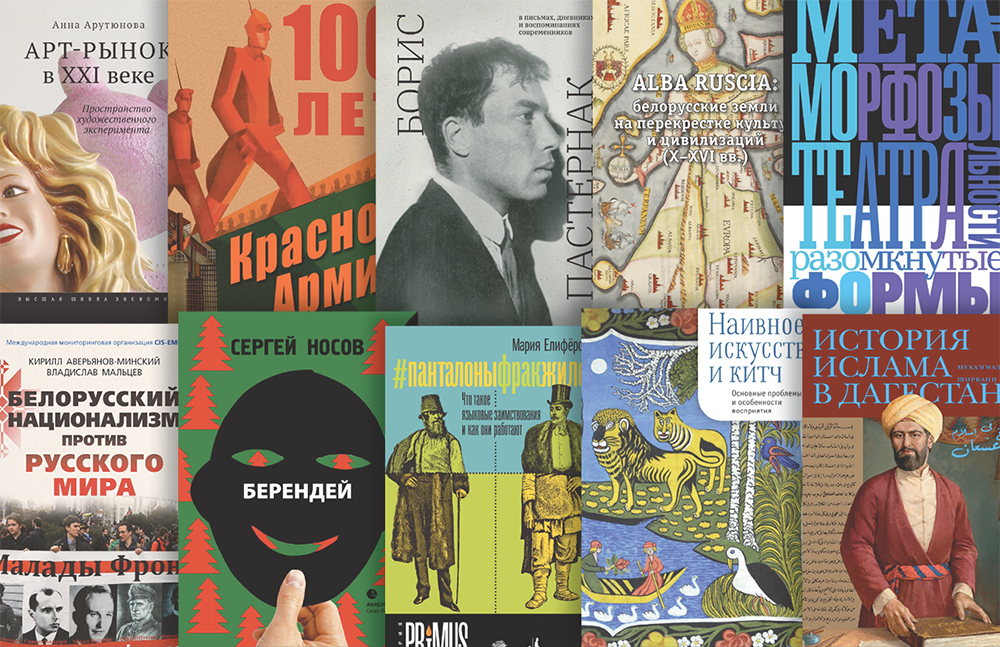
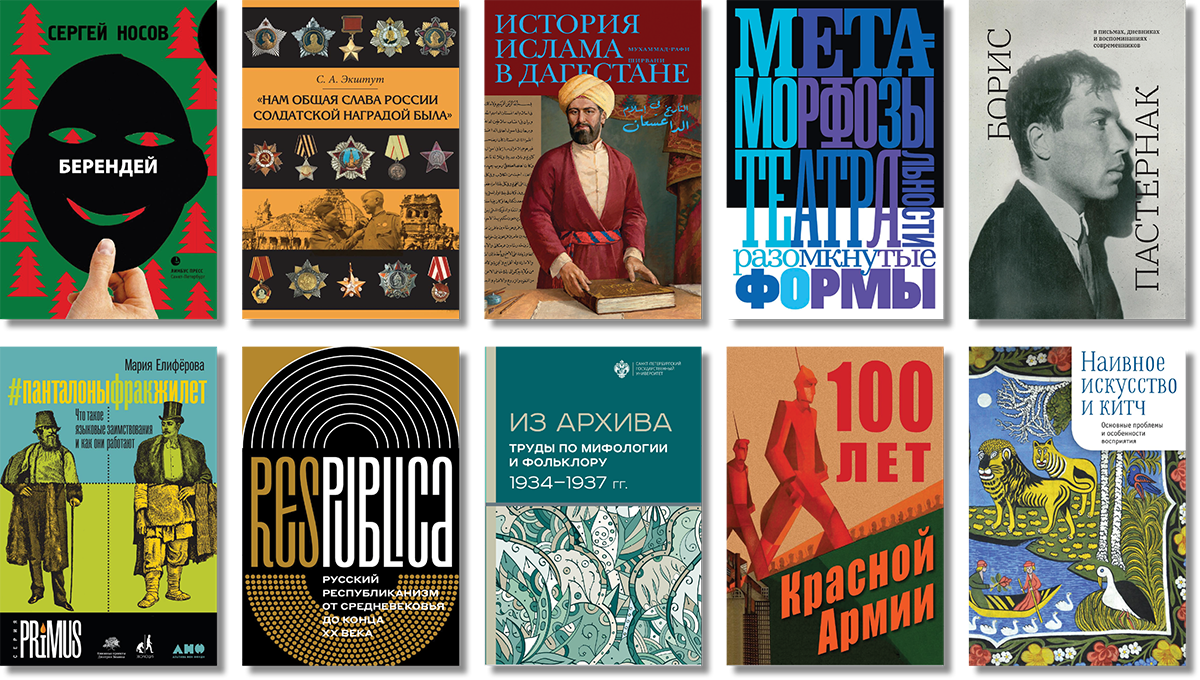
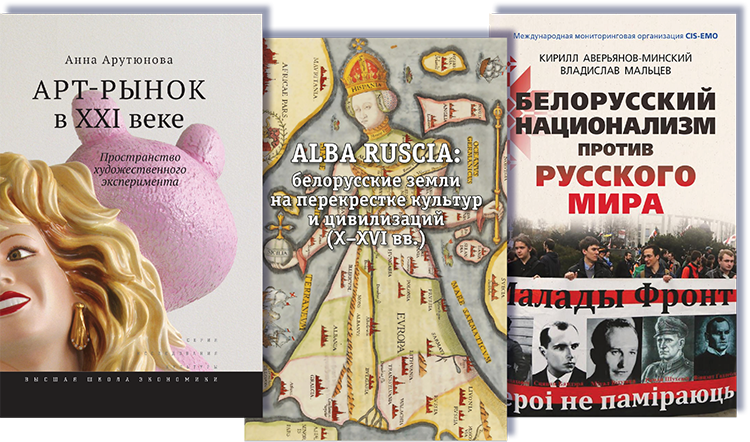
Infoteka offers a growing selection of e-books on hundreds of topics from premier scholarly publishers in Russia, Belarus, and Central Asia. Choose from among classics, modern literature, popular fiction, scholarly titles, and more, as single titles or publisher sets.
Infoteka’s intuitive e-book platform allows users to search within individual works, whole collections, and cross-search between e-book collections and your other online Infoteka resources. E-books may be supplied through an approval plan program or as firm orders
One of the most significant illustrated literary and cultural journals of the early Soviet period.
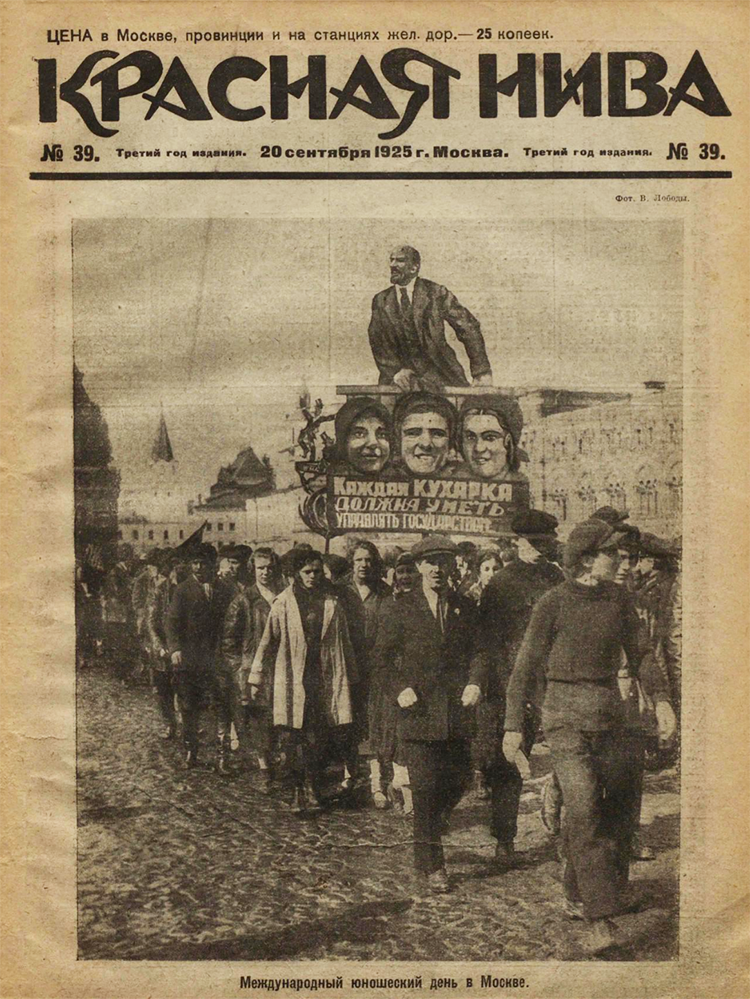
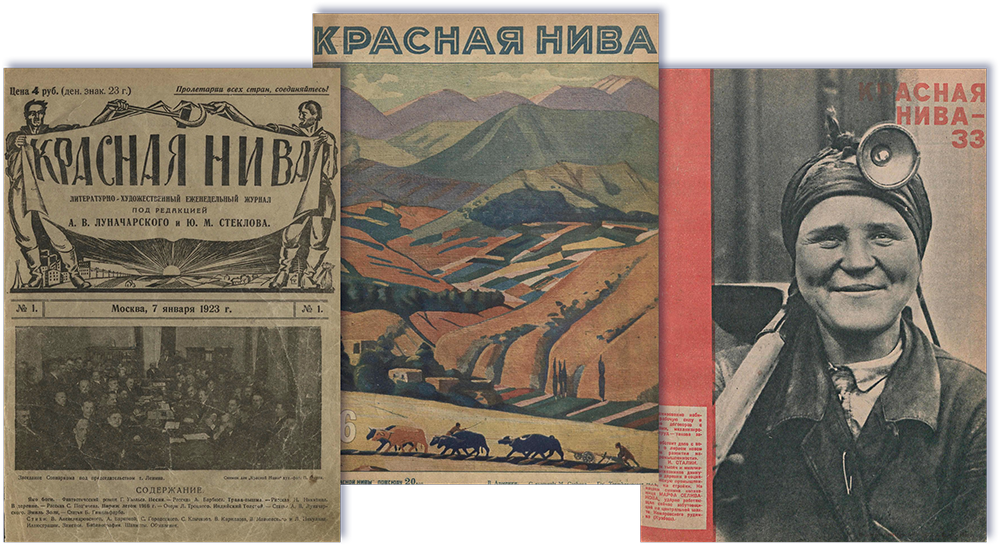
Published in Moscow from 1923 to 1931 as a supplement to Izvestiia, Krasnaia Niva (Красная Нива, The Red Field) was conceived as a Soviet successor to the famous pre-revolutionary illustrated weekly Niva. Like its predecessor, it was designed for a broad reading public and combined literature, poetry, essays, popular science, cultural commentary, criticism, biography, current affairs, and abundant visual material.
Appearing during the formative decade between the end of the Civil War and the consolidation of Stalinist cultural policy, Krasnaia Niva offers an unusually rich record of Soviet intellectual and artistic life before the full standardization of Socialist Realism and the later mechanisms of cultural control. Its pages preserve the pluralism, contradictions, and experimentation of the 1920s: revolutionary rhetoric coexists with literary variety, popular education, internationalism, peasant themes, technological enthusiasm, satire, and visual modernism.
Krasnaia Niva published fiction and poetry by major and now-canonical writers, including Aleksandr Grin, Boris Pilniak, Mikhail Prishvin, Andrei Platonov, Vladimir Mayakovsky, Sergei Esenin, and others. It also featured translated literature by such international authors as Henri Barbusse, Romain Rolland, and O. Henry, reflecting the early Soviet effort to situate Russian readers within a global literary and political culture. Because some of its contributors later became politically suspect, marginalized, censored, or retrospectively rewritten out of Soviet literary history, the archive is especially valuable for reconstructing the cultural openness and instability of the 1920s.
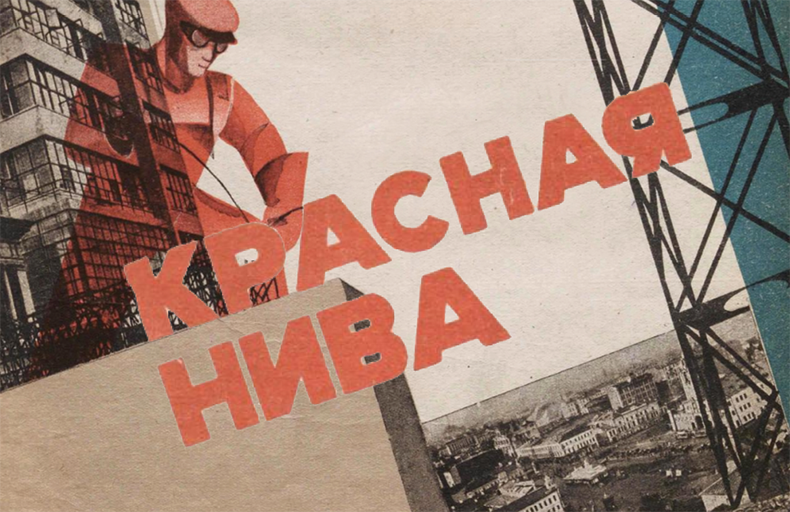
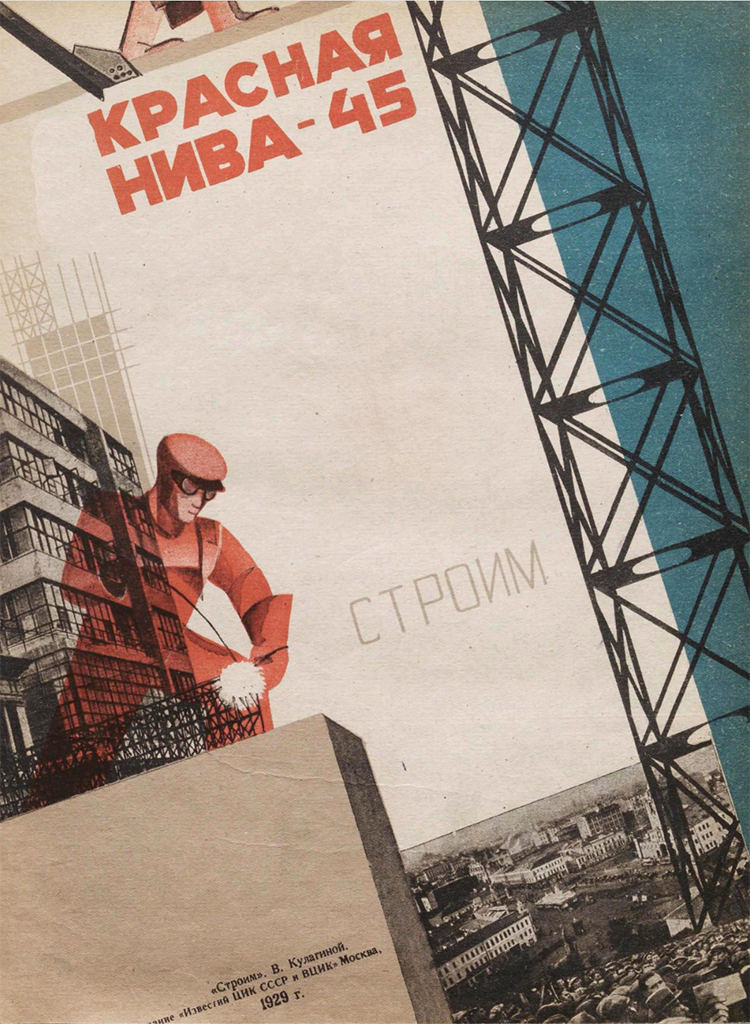
As an illustrated magazine, Krasnaia Niva is also an important source for the study of Soviet visual culture. Its pages feature reproductions of artworks, drawings, caricatures, decorative layouts, and striking cover designs that trace the changing graphic language of the early Soviet period—from post-revolutionary illustration and political satire to photomontage, Constructivist design, and the increasingly monumental imagery of socialist construction.
The journal’s visual significance is underscored by the fact that MoMA in New York holds Krasnaia Niva, no. 45, 1929, designed by Valentina Kulagina, as a letterpress-printed journal with a lithographed cover, associated with the Merrill C. Berman Collection of modern graphic material.
Krasnaia Niva, no. 45, 1929
The Krasnaia Niva Digital Archive is particularly valuable for scholars and students working in Slavic studies, Soviet history, Russian literature, art history, visual culture, media studies, book history, comparative literature, translation studies, and the history of popular science. It supports research into the New Economic Policy period, Soviet readership and mass culture, the transformation of the illustrated press, debates over “fellow travelers” and proletarian literature, representations of peasants and workers, the emergence of the “new Soviet everyday life,” and the gradual narrowing of cultural expression under ideological pressure.
The Krasnaia Niva Digital Archive offers scholars the most comprehensive collection available for this title. It includes fully searchable scans of every issue, preserving the visual and textual richness of the original print editions, and is cross-searchable with numerous other Infoteka digital resources. By making the full run searchable and accessible in digital form, the archive allows researchers to move beyond isolated famous texts or individual issues and instead trace themes, authors, images, genres, and ideological vocabulary across nearly a decade of Soviet cultural development. It is an essential primary-source archive for understanding how early Soviet culture was presented to a mass readership.
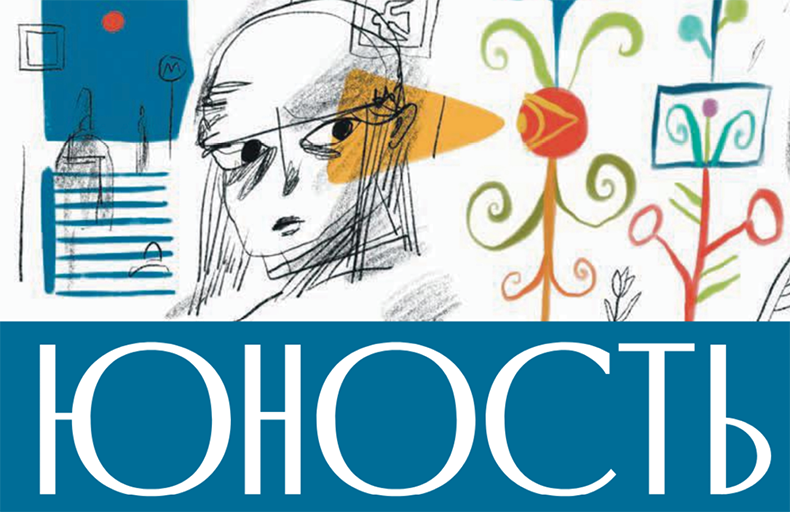
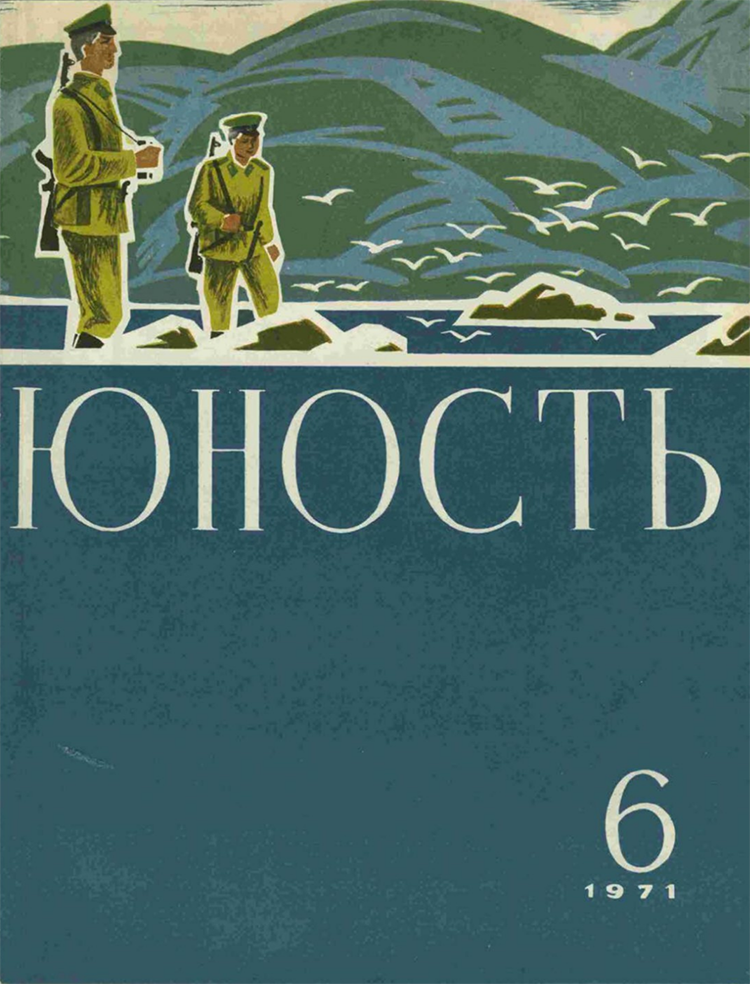
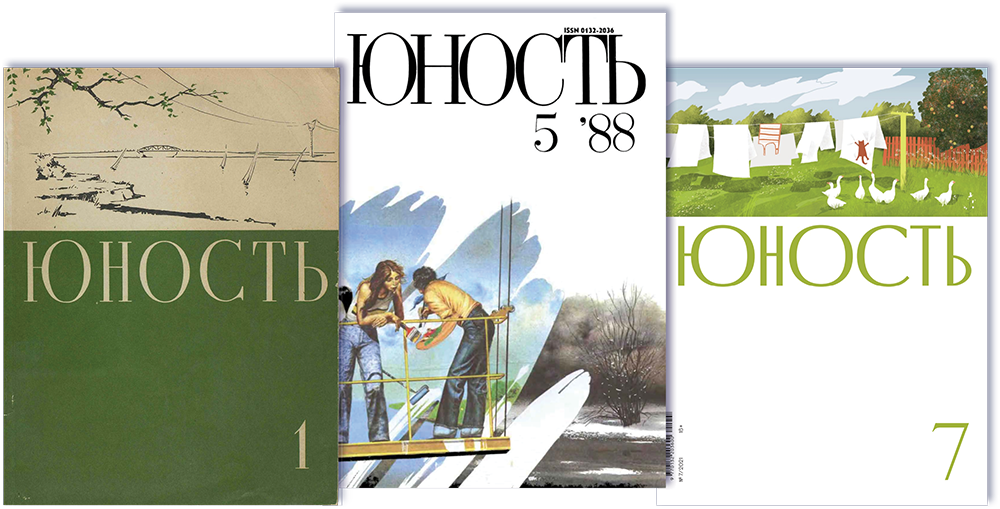
Founded in Moscow in 1955 at the initiative of writer Valentin Kataev, Iunost’ (Юность, Youth) was one of the most influential Soviet and later Russian illustrated literary journals addressed to younger readers, as well as one of the esteemed Soviet/Russian “thick journals.” During the cultural “Thaw,” Iunost’ emerged as an important venue for new literary voices and for writing that departed from established conventions of socialist realism. Its pages introduced readers to a remarkable generation of authors, including Vasily Aksenov, Anatoly Gladilin, Bella Akhmadulina, Andrei Voznesensky, Yevgeny Yevtushenko, Bulat Okudzhava, Fazil Iskander, Boris Vasilyev, Vladimir Voinovich, and many others.
The Iunost’ Digital Archive provides scholars with a rich primary-source record of Soviet and post-Soviet literary culture, youth identity, intellectual life, and changing boundaries of permissible expression. Beyond fiction and poetry, the journal engaged with contemporary society through writing on science and technology, sports, popular culture, art, and public debate. Its illustrated format, color art inserts, humor sections, and discussion forums make it a valuable resource not only for literary studies, but also for research in Soviet cultural history, media studies, visual culture, youth studies, censorship, and the history of everyday life.
For academic libraries, the Iunost’ Digital Archive offers access to a publication that helped shape the literary and cultural experience of multiple generations. The archive enables researchers and students to trace the emergence of major authors, examine literary experimentation during the Thaw and later Soviet decades, study the interaction between cultural liberalization and political constraint, and follow the journal’s continued evolution after 1991 as an independent Russian literary publication. As a sustained record of literary discovery, cultural change, and youth-oriented public discourse, the archive is an essential addition to collections supporting Slavic studies, Russian literature, Soviet history, and modern European cultural research.
The Iunost’ Digital Archive offers scholars the most comprehensive collection available for this title, with an additional year’s worth of content available for purchase on an annual basis. It includes fully searchable scans of every issue, preserving the visual and textual richness of the original print editions, and is cross-searchable with numerous other Infoteka digital resources.
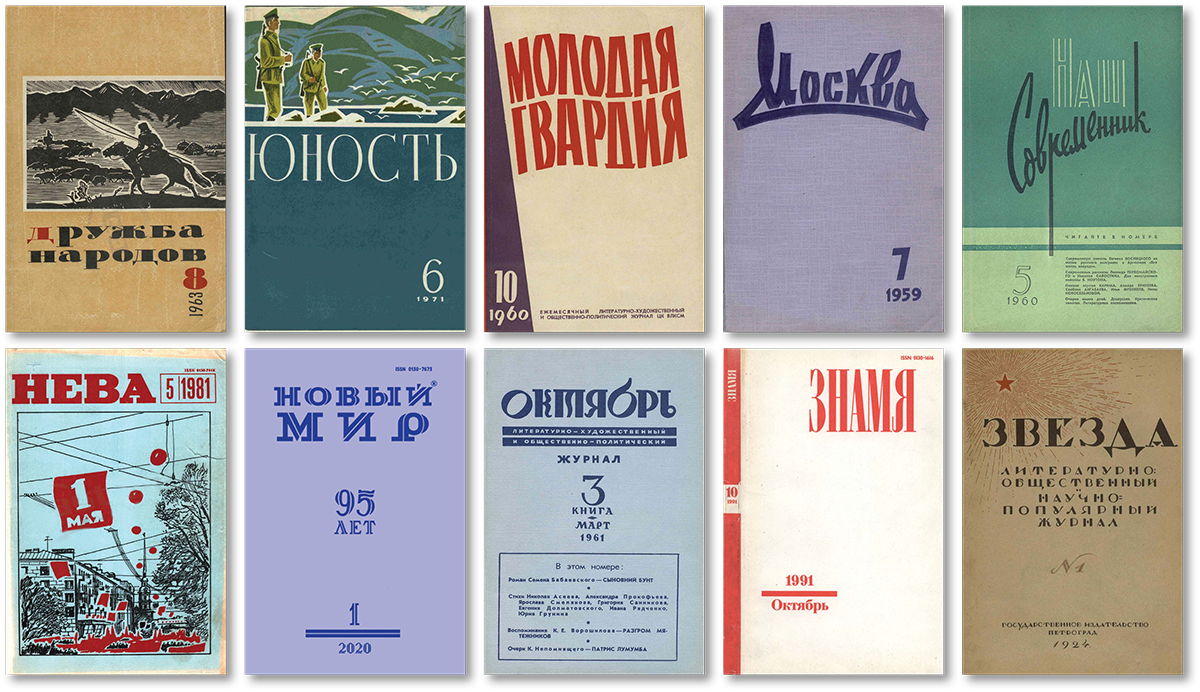
The famed Soviet tolstye zhurnaly, or “thick journals,” were significant platforms for literary and intellectual discourse. Tolstye zhurnaly such as Iunost’ played a complex and multifaceted role in Soviet intellectual and literary life. They were not merely publications but institutions that shaped and were shaped by the cultural, intellectual, and political currents of their time. These journals served multiple roles:
They acted as repositories of high culture, preserving the intellectual and literary achievements of the era. Given the limited avenues for independent publishing, these journals were the primary platforms where established and emerging writers could reach an audience.
State-Controlled Outlets. While they were crucial platforms for intellectual and artistic expression, it’s important to remember that these journals were often used to propagate official ideologies, and the works published in them usually underwent rigorous censorship.
Academic Importance. For academics studying the Soviet period, tolstye zhurnaly offer a valuable glimpse into the state-sanctioned intellectual climate of the time. They provide context for how literature and intellectual thought evolved under different political and social conditions.
Catalysts for Change. During more liberal periods, such as the Khrushchev Thaw and the perestroika years, tolstye zhurnaly could act as catalysts for change, pushing the boundaries of what was acceptable to discuss and publish.
Official journal of the Young Communist League, tasked with shaping Soviet youth.
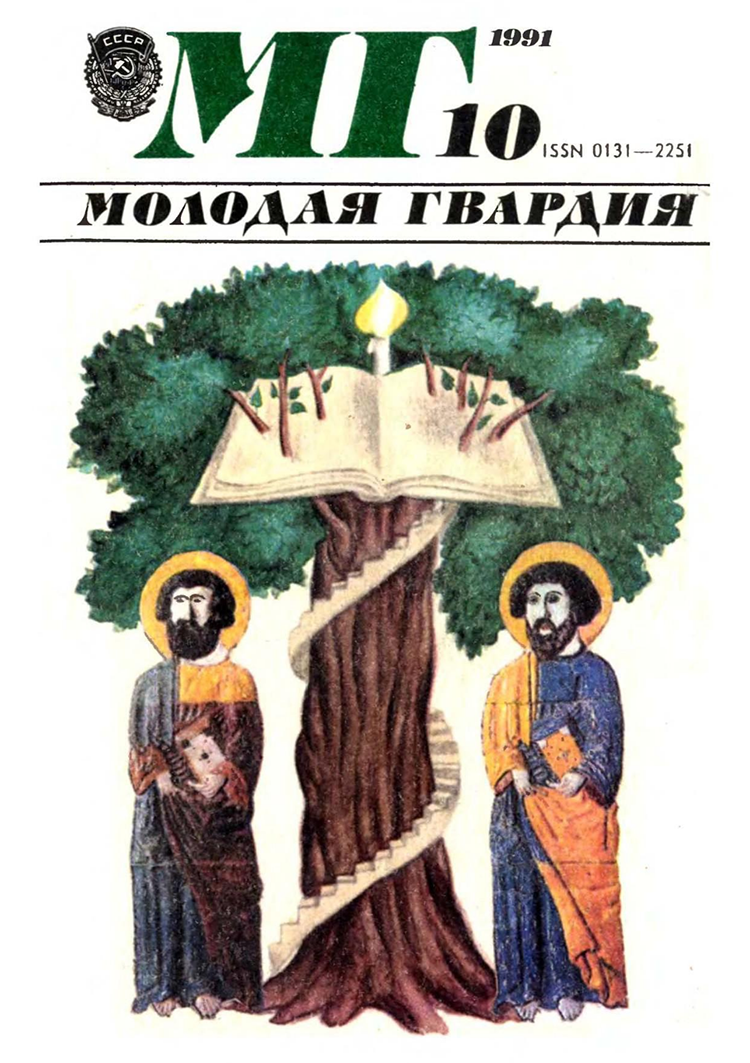
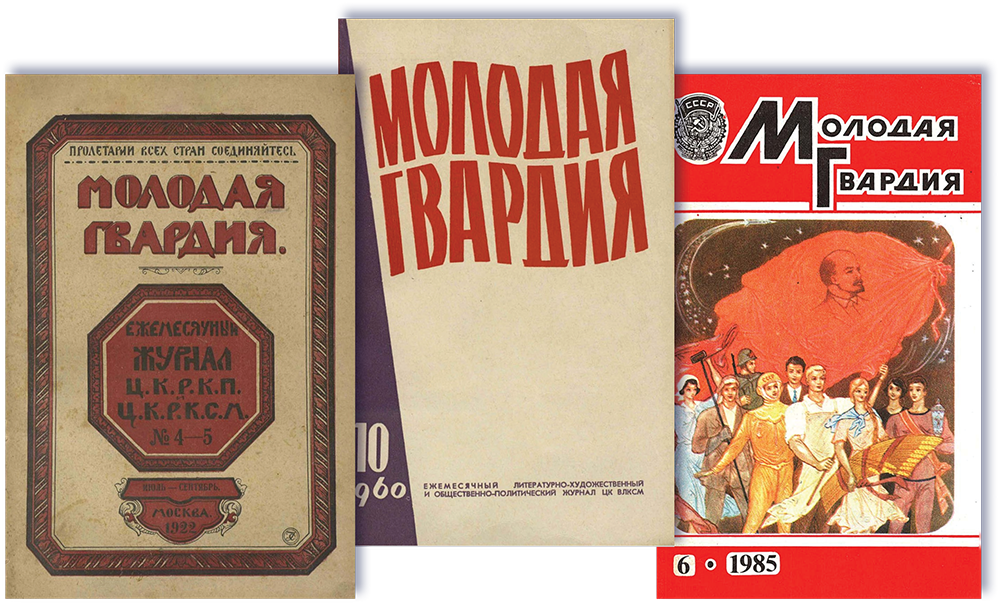
Founded in Moscow in 1922 as the official monthly organ of the Central Committee of the Komsomol, Molodaia Gvardiia (Молодая гвардия, Young Guard) was established to shape Soviet youth through a powerful fusion of literature, ideology, and political commentary. One of the esteemed Soviet/Russian “thick journals,” Molodaia Gvardiia has published continuously since 1922 except during the war years (1942–1947), when it was suspended and later issued as a literary almanac. The journal resumed regular publication in 1956 and has retained its monthly frequency ever since.
From its early years, Molodaia Gvardiia served as a cultural training ground for aspiring Soviet writers and political thinkers, with early works by figures like Osip Mandelstam and Mikhail Sholokhov. Over the decades, it played a central role in shaping what would later be known as Russophile discourse, particularly during and after the Khrushchev Thaw.
In the post-war decades, the journal came to be associated with a nationalist and traditionalist line. During the Gorbachev years, Molodaia Gvardiia was among the few Soviet journals that openly resisted perestroika, becoming a voice for those opposed to liberalization. Though its audience has diminished in the post-Soviet period, Molodaia Gvardiia remains a living institution of Russian conservative thought and literary life. Since 2009, it has been edited by Valerii Khatushin and continues to be published monthly in Moscow.
The Molodaia Gvardiia Digital Archive provides researchers, students, and historians with a unique window into Soviet and post-Soviet cultural and ideological dynamics, spanning a century of literary evolution, political debate, and generational change. Users can trace the journal’s transformation over time: from its foundational role in Soviet youth mobilization and its post-war embrace of conservative, Russophile thought, to its defiant stance during the Gorbachev era and continued relevance in contemporary Russian discourse.
This comprehensive resource includes fully searchable scans of every issue, preserving the visual and textual richness of the original print editions. The archive offers scholars the most comprehensive collection available for this title, with an additional year’s worth of content available for purchase on an annual basis. The archive is cross-searchable with numerous other Infoteka digital resources.
The famed Soviet tolstye zhurnaly, or “thick journals,” were significant platforms for literary and intellectual discourse. Tolstye zhurnaly such as Molodaia Gvardiia played a complex and multifaceted role in Soviet intellectual and literary life. They were not merely publications but institutions that shaped and were shaped by the cultural, intellectual, and political currents of their time. These journals served multiple roles:
They acted as repositories of high culture, preserving the intellectual and literary achievements of the era. Given the limited avenues for independent publishing, these journals were the primary platforms where established and emerging writers could reach an audience.
State-Controlled Outlets. While they were crucial platforms for intellectual and artistic expression, it’s important to remember that these journals were often used to propagate official ideologies, and the works published in them usually underwent rigorous censorship.
Academic Importance. For academics studying the Soviet period, tolstye zhurnaly offer a valuable glimpse into the state-sanctioned intellectual climate of the time. They provide context for how literature and intellectual thought evolved under different political and social conditions.
Catalysts for Change. During more liberal periods, such as the Khrushchev Thaw and the perestroika years, tolstye zhurnaly could act as catalysts for change, pushing the boundaries of what was acceptable to discuss and publish.
Key resource of Russian intellectual and literary circles for over a century.
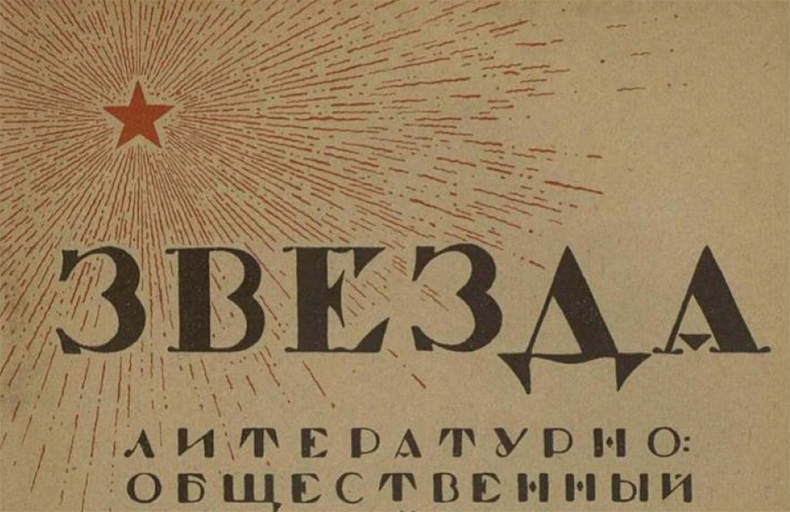
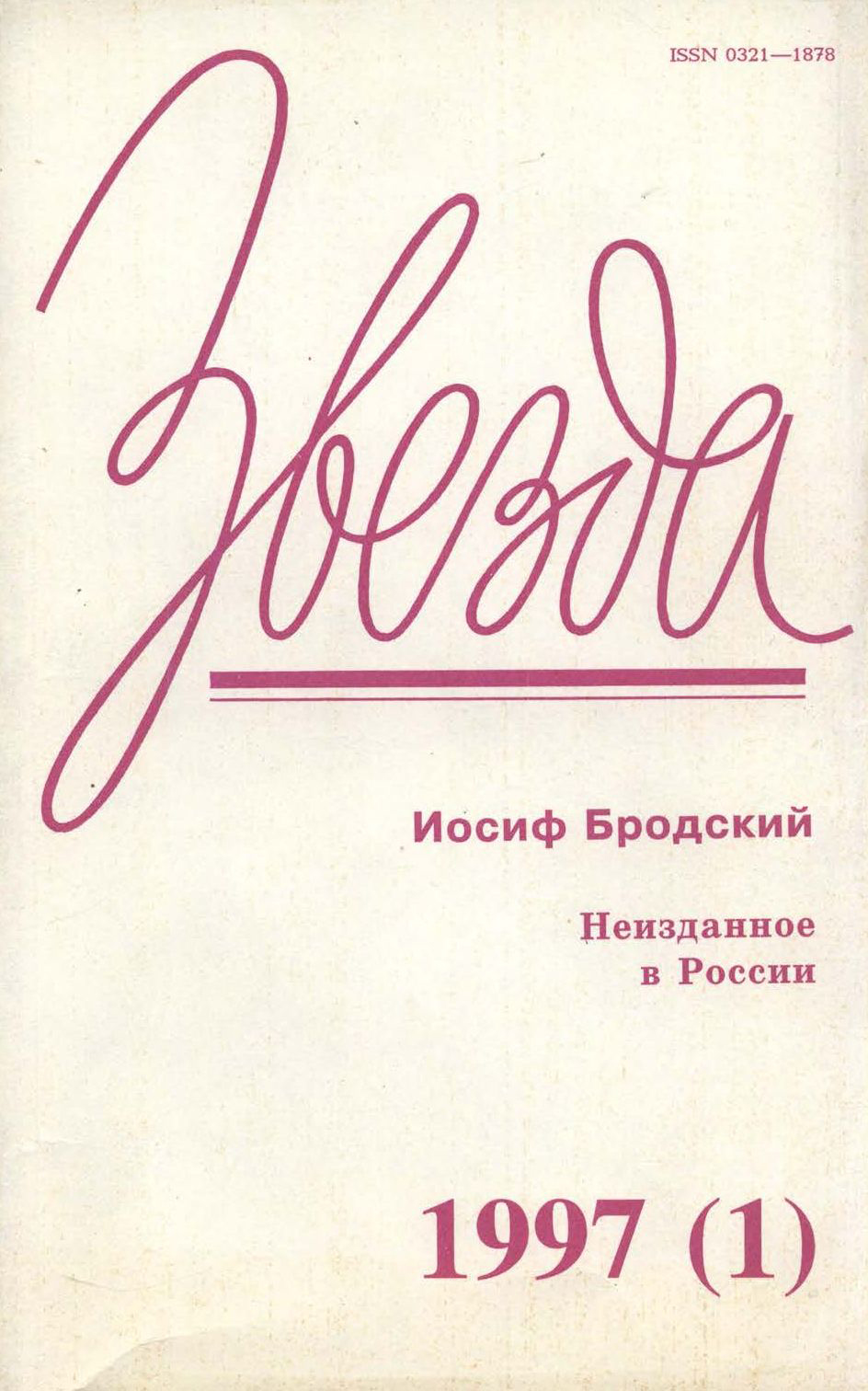
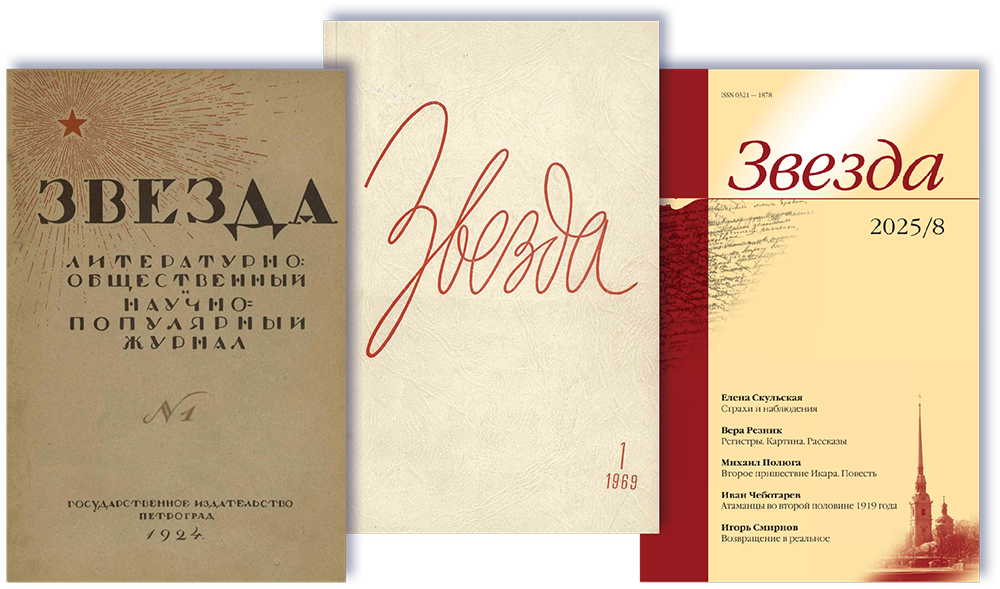
Founded in 1924 in Petrograd (later Leningrad, now St. Petersburg), Zvezda(Звезда, The Star) is Russia’s oldest monthly “thick journal,” a group of publications that played a crucial role in shaping Soviet intellectual and literary discourse. Initially released six times a year, it became a monthly publication in 1927 and has been a key resource of Russian intellectual and literary circles for a century.
The journal’s longevity and resilience through tumultuous periods of Soviet history, including the Siege of Leningrad and Stalinist repression, make it an essential resource for understanding the complexities of Russian cultural development over the past century. Notably, Zvezda faced severe criticism in August 1946 from the Soviet Communist Party in the infamous resolution “On the Journals ‘Zvezda’ and ‘Leningrad’,” where it was accused of publishing “ideologically harmful works,” particularly those by Mikhail Zoshchenko and Anna Akhmatova. During the era of perestroika, Zvezda began publishing previously prohibited works and articles by authors such as Alexander Solzhenitsyn, Joseph Brodsky, Andrei Sakharov, Yuri Lotman and many others.
The Zvezda Digital Archive provides a panoramic view of Russian intellectual life across the 20th and 21st centuries, and the journal’s survival through periods of intense censorship and its role in pushing boundaries during more liberal times make it an essential resource for understanding the nuanced tapestry of Russian culture, literature, and thought.
This extensive coverage provides researchers with access to:
Literary works by established and emerging Russian writers
Critical essays and reviews on literature, art, and culture
Discussions of social and political issues within the constraints of the era
Previously prohibited works published during the perestroika period
Evolving perspectives on Russian identity and cultural heritage
The Zvezda Digital Archive offers a comprehensive collection spanning over 100 years, with an additional year’s worth of content available for purchase on an annual basis. The archive includes more than 25,000 works by over 10,000 authors, encompassing nearly 1,200 issues, over 23,000 articles, and over 280,000 pages. If converted to print, the archive for this title would occupy 49 feet of library shelf space. Thearchive offers scholars the most comprehensive collection available for this title, and features full page-level digitization and complete original graphics. The archive has searchable text and is cross-searchable with numerous other Infoteka digital resources.
Note: In 1992 only 10 issues of Zvezda were published. This is not a gap in archive content but reflects the journal’s publication schedule that year.
The famed Soviet tolstye zhurnaly, or “thick journals,” were significant platforms for literary and intellectual discourse. Tolstye zhurnaly such as Zvezda played a complex and multifaceted role in Soviet intellectual and literary life. They were not merely publications but institutions that shaped and were shaped by the cultural, intellectual, and political currents of their time. These journals served multiple roles:
They acted as repositories of high culture, preserving the intellectual and literary achievements of the era. Given the limited avenues for independent publishing, these journals were the primary platforms where established and emerging writers could reach an audience.
State-Controlled Outlets. While they were crucial platforms for intellectual and artistic expression, it’s important to remember that these journals were often used to propagate official ideologies, and the works published in them usually underwent rigorous censorship.
Academic Importance. For academics studying the Soviet period, tolstye zhurnaly offer a valuable glimpse into the state-sanctioned intellectual climate of the time. They provide context for how literature and intellectual thought evolved under different political and social conditions.
Catalysts for Change. During more liberal periods, such as the Khrushchev Thaw and the perestroika years, tolstye zhurnaly could act as catalysts for change, pushing the boundaries of what was acceptable to discuss and publish.
Prominent literary journal in publication since 1931.
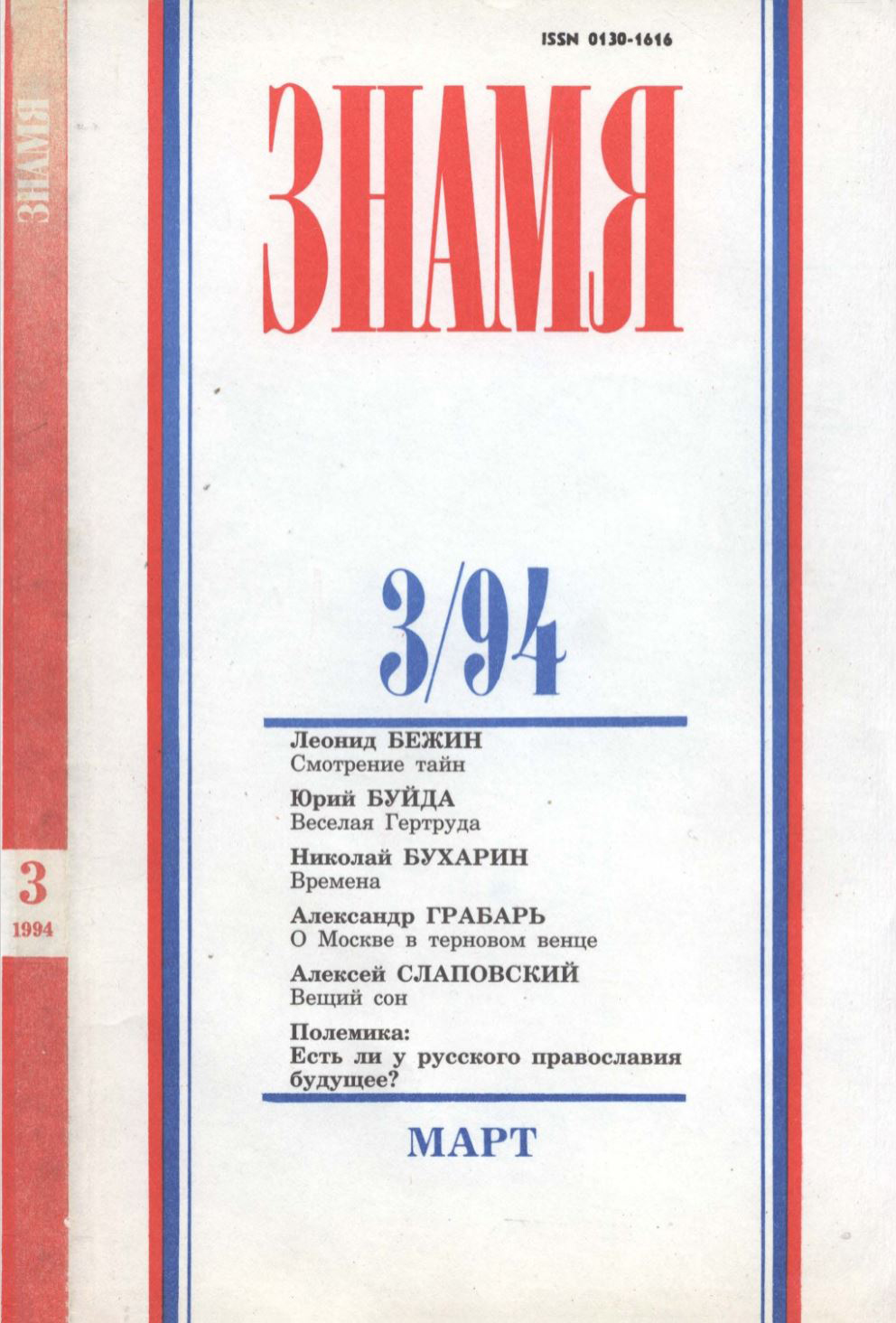
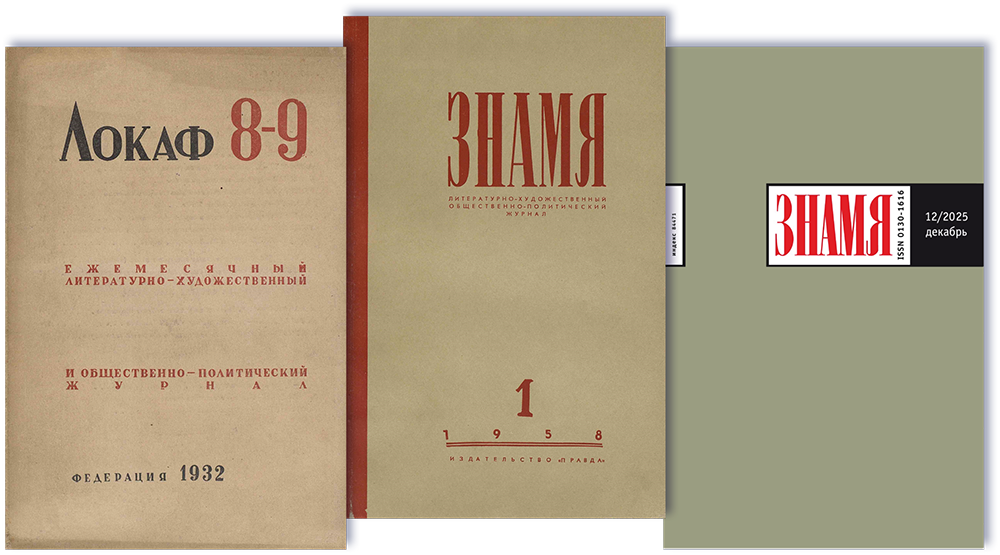
Znamia (Знамя, Banner), an esteemed Soviet/Russian “thick journal,” is a lively platform for literature, critical analysis, philosophy, and at times, political commentary. Originally launched in January 1931 under the name LOKAF (Локаф), an acronym for the Literary Association of the Red Army and Navy, the journal was officially rebranded as Znamia in 1933. Throughout its history, Znamia has been a pivotal venue for showcasing the works of preeminent authors such as Anna Akhmatova, Alexander Tvardovsky, Yevgeny Yevtushenko, Konstantin Paustovsky, Yuri Kazakov, and Yuri Trifonov. During the perestroika era, Znamia underwent a significant transformation, evolving into one of Russia’s most widely read literary journals and serving as a herald of the perestroika movement.
The Znamia Digital Archive contains all obtainable published issues from 1931 on, with an additional year’s worth of content available for purchase on an annual basis. Spanning over nine decades, it contains over 25,000 articles, or around 260,000 pages. If converted to print, the archive for this title would occupy 41 feet of library shelf space. The archive offers scholars the most comprehensive collection available for this title, and features full article-level digitization, complete original graphics, and searchable text, and is cross-searchable with numerous other Infoteka digital resources.
The famed Soviet tolstye zhurnaly, or “thick journals,” were significant platforms for literary and intellectual discourse. Tolstye zhurnaly such as Znamia played a complex and multifaceted role in Soviet intellectual and literary life. They were not merely publications but institutions that shaped and were shaped by the cultural, intellectual, and political currents of their time. These journals served multiple roles:
They acted as repositories of high culture, preserving the intellectual and literary achievements of the era. Given the limited avenues for independent publishing, these journals were the primary platforms where established and emerging writers could reach an audience.
State-Controlled Outlets. While they were crucial platforms for intellectual and artistic expression, it’s important to remember that these journals were often used to propagate official ideologies, and the works published in them usually underwent rigorous censorship.
Academic Importance. For academics studying the Soviet period, tolstye zhurnaly offer a valuable glimpse into the state-sanctioned intellectual climate of the time. They provide context for how literature and intellectual thought evolved under different political and social conditions.
Catalysts for Change. During more liberal periods, such as the Khrushchev Thaw and the perestroika years, tolstye zhurnaly could act as catalysts for change, pushing the boundaries of what was acceptable to discuss and publish.
Influential Russian journal of literary criticism and literary studies.
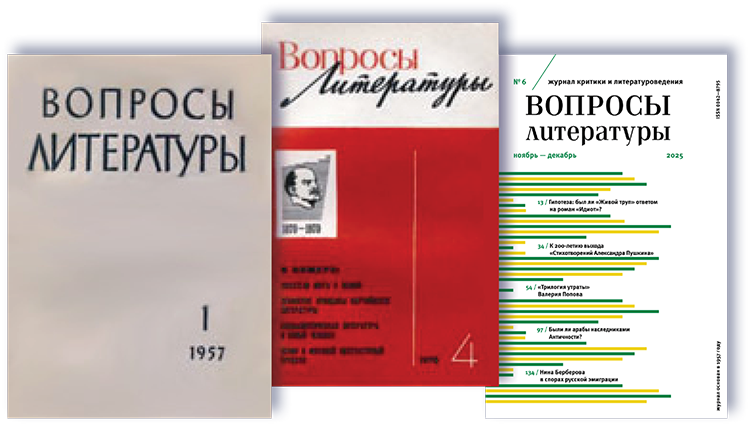
Since its inception in 1957, Voprosy Literatury (Вопросы литературы, Issues of Literature) has stood as one of the most prestigious and authoritative academic journals in the fields of philology and literary criticism in the Russian language. Founded soon after the 20th Congress of the Communist party of the Soviet Union and the beginning of the era known as the “thaw” in USSR cultural life, it soon evolved into a major discussion platform for literary critics and scholars on the history of world and Russian literature, the theory of literature, and current literary and cultural issues in the country.
Recent years have seen the journal engage in rigorous debates about the future of philological science and, more broadly, the state of the humanities, attracting significant attention within Russia. Among the major themes explored by the journal are: methods and techniques in modern philological science, comparative study of cultures and the history of classical and contemporary Russian literature.
Voprosy Literatury boasts an illustrious list of past and present contributors, including leading Russian and international scholars such as M.M. Bakhtin, V.B. Shklovsky, D.S. Likhachev, L.E. Pinsky, S.S. Averintsev, Caryl Emerson, and J.S. Smith, among others. It is also known for publishing selections from Russian writers prohibited during the Soviet period.
The journal is included in the official Russian list of peer-reviewed publications where the main scientific results of dissertations must be published. It is also indexed in the Scopus database, making it a widely acknowledged and cited publication in academic circles.
The Voprosy Literatury Digital Archive serves as an indispensable resource for scholarly research in the fields of philology and literary criticism. With access to decades of seminal articles, debates, and academic discussions, this comprehensive archive represents a cornerstone in the landscape of humanities scholarship.
The archive contains the most complete set of the journal, comprising more than 16,000 articles, with an additional year’s worth of content available for purchase on an annual basis. It features searchable full-text articles with PDF format available starting in 2018. All content in the Voprosy Literatury Digital Archive is cross-searchable with numerous other Infoteka digital resources.
Product Code: DA-VL
Year First Published: 1957
Archive: 1957–2025
Language: Russian
Country: Russia
City: Moscow
Frequency: Monthly
Format: Full text; article-based PDFs starting in 2018
A major influence on the outlook of 19th century Russian intellectuals.
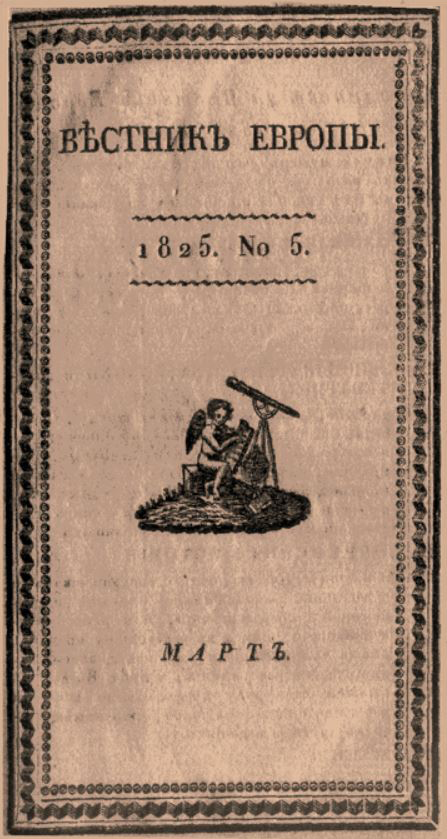
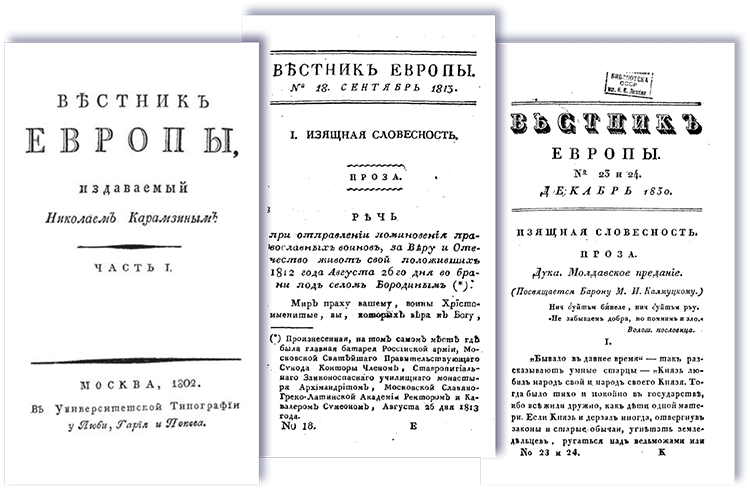
Vestnik Evropy(Вестник Европы, Herald of Europe) was one of the first literary and political journals published in the time of the Russian Empire. Published in Moscow from 1802–1830, it was founded by Nikolay Karamzin, a well-known author and historian. The aim of Vestnik Evropy was to provide Russian intellectuals – those that considered themselves “European Russians” – with cultural, historical, political, and literary thought from Europe. Vestnik Evropy soon became a major influence in the development of a European outlook in Russia. The journal included works of fiction and poems from Russian authors, and articles on politics and social life in Russia as well as in other countries. In 1814 Vestnik Evropy published the first poems of Aleksandr Pushkin, just one of many well-known contributors, including the talented poets Zhukovsky, Derzhavin, Vyazemsky and Batyushkov.
The Vestnik Evropy Digital Archive comprises the entire collection of the journal, with more than 8,500 articles and over 57,000 pages. The archive offers scholars the most comprehensive collection available for this title, and features full-text articles, with full page-level digitization and complete original graphics. The archive has searchable text, and is cross-searchable with numerous other Infoteka digital resources.
Note:Vestnik Evropy was published before the Russian Revolution and was written using the pre-reform Russian orthography. To enable searching functionality, Infoteka worked closely with consultants from the Institute of Russian Language in Moscow to adapt the Old Russian script into modern Russian orthography. The archive has been designed so researchers may work simultaneously with texts in Old (pre-revolutionary) Russian and normalized contemporary orthography with easy-to-use cross search functionality.
Scholarly journals from St. Petersburg University on a wide range of topics.
St. Petersburg University Press offers online access to scholarly and scientific works published in the renowned Vestnik SpbU (Вестник Санкт-Петербургского университета), a journal of science and theory that features educational and scientific literature on social and natural sciences, engineering and technology. Established in 1946, St. Petersburg University Press publishes innovative theoretical, experimental, and practical research, as well as reports on the achievements of the University’s research institutes and schools. The publications reflect high-quality and objective viewpoints from various schools of research, along with collaboration with foreign authors, research centers, and other publishers. The editorial board of Vestnik SpbU is drawn from prominent academic researchers with leading works in the sciences, humanities, and social sciences.
St. Petersburg University Press includes 17 series (listed below) with an archive going back to 2013. All articles are presented in the original PDF format in Russian, with abstracts in English.
Mathematics. Mechanics. Astronomy
History
Biology
Physics. Chemistry
Economy
Political Science. International Relations
Geology. Geography
Management
Language and Literature
Applied Mathematics. Information Science. Management Processes
Medicine
Sociology
Oriental and African Studies
Law
Art Studies
Psychology. Pedagogy
Philosophy. Conflict Studies. Cultural Studies. Religion Studies
An indispensable source on Soviet and Russian arts and culture.
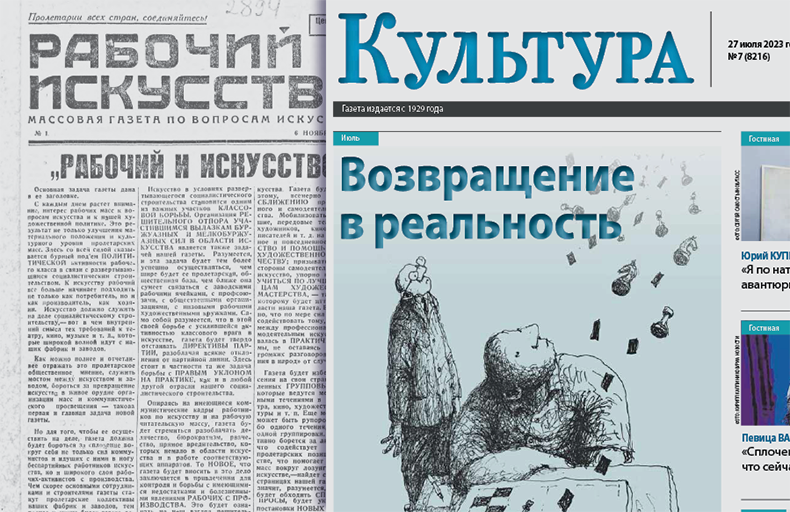
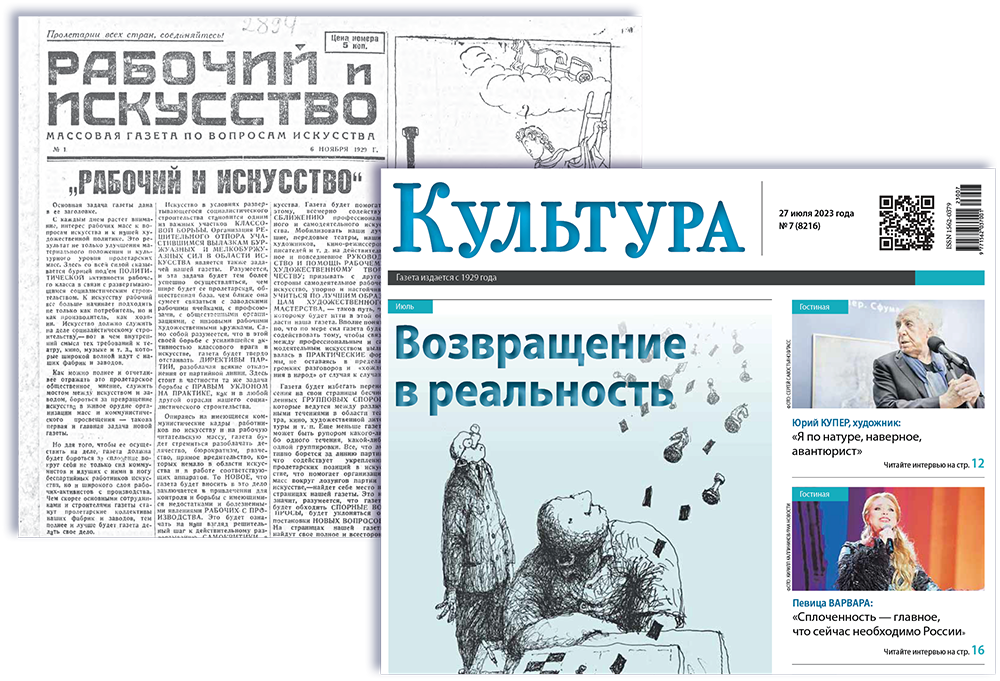
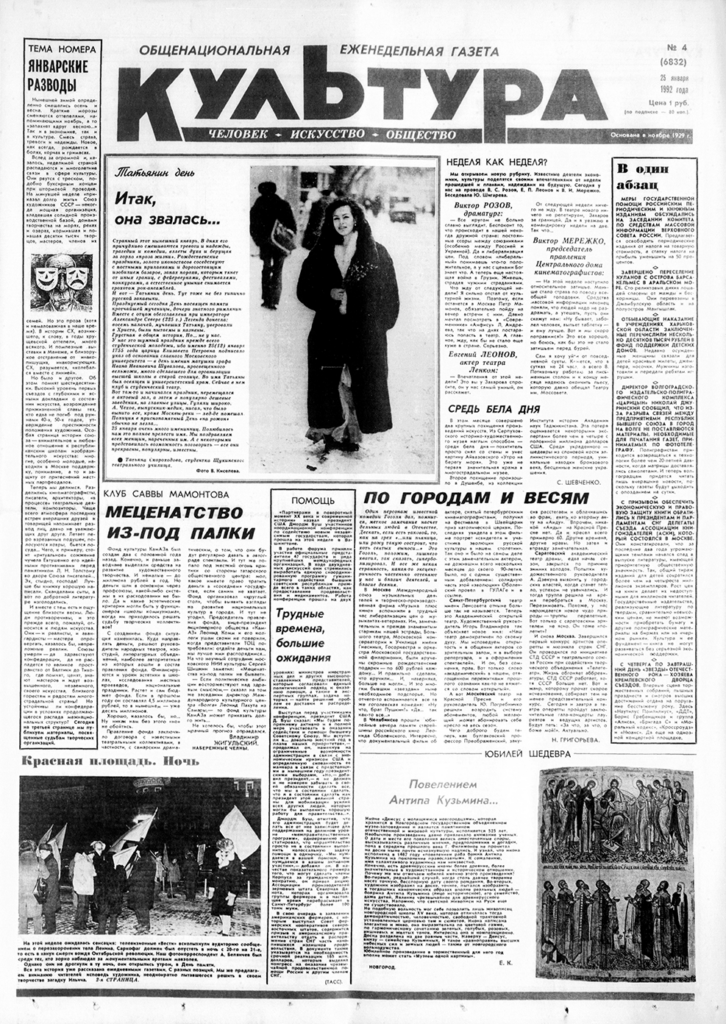
Kul’tura(Культура, Culture), as it is known today, is the most important Soviet and Russian publication on culture from 1929 to the present, with reviews of major events in literature, theater, cinematography and the arts. For nearly 100 years, Kul’tura has served as a time capsule of Soviet and Russian culture, providing a unique perspective on ever-changing attitudes toward arts and culture in Soviet and Russian societies.
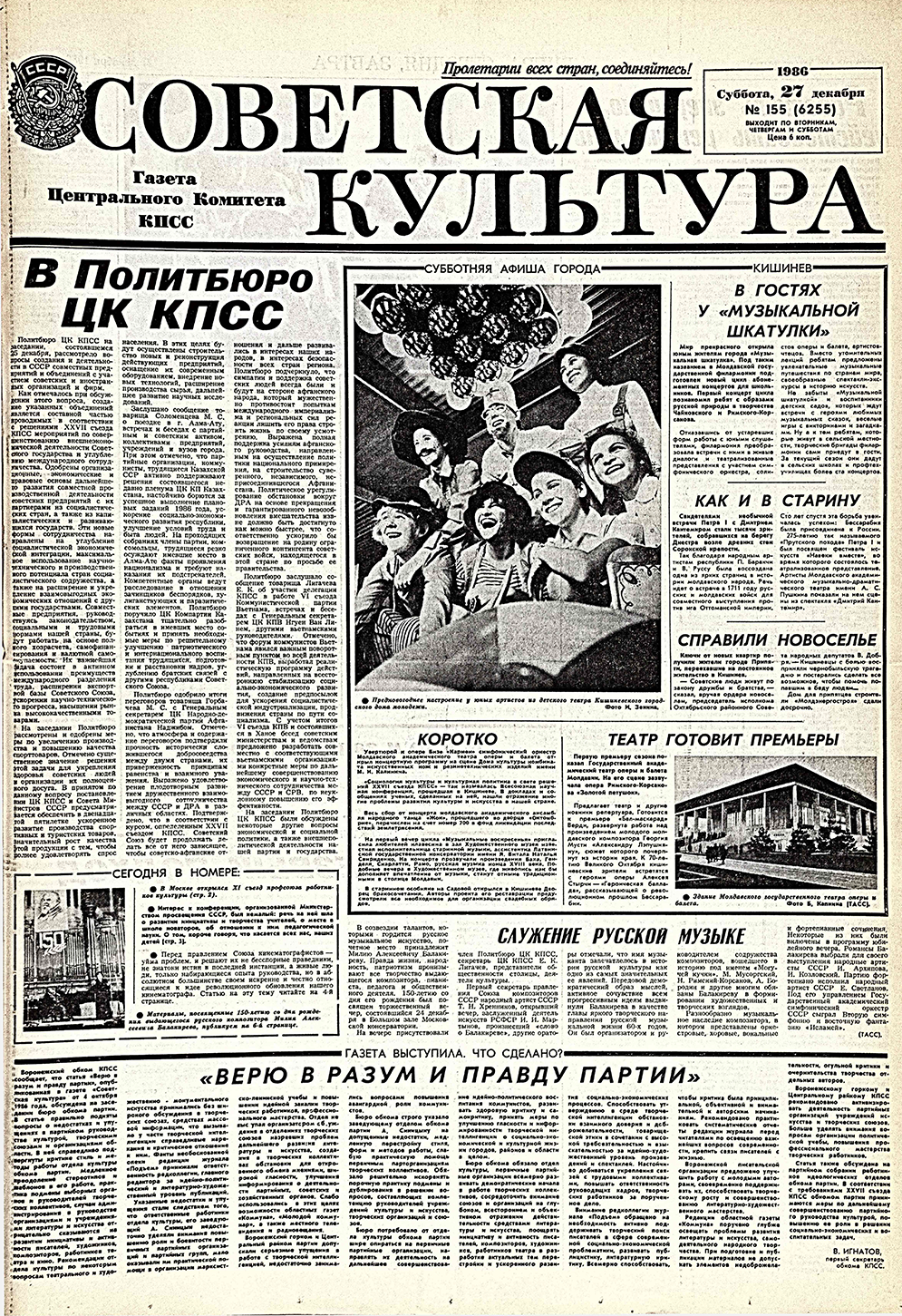
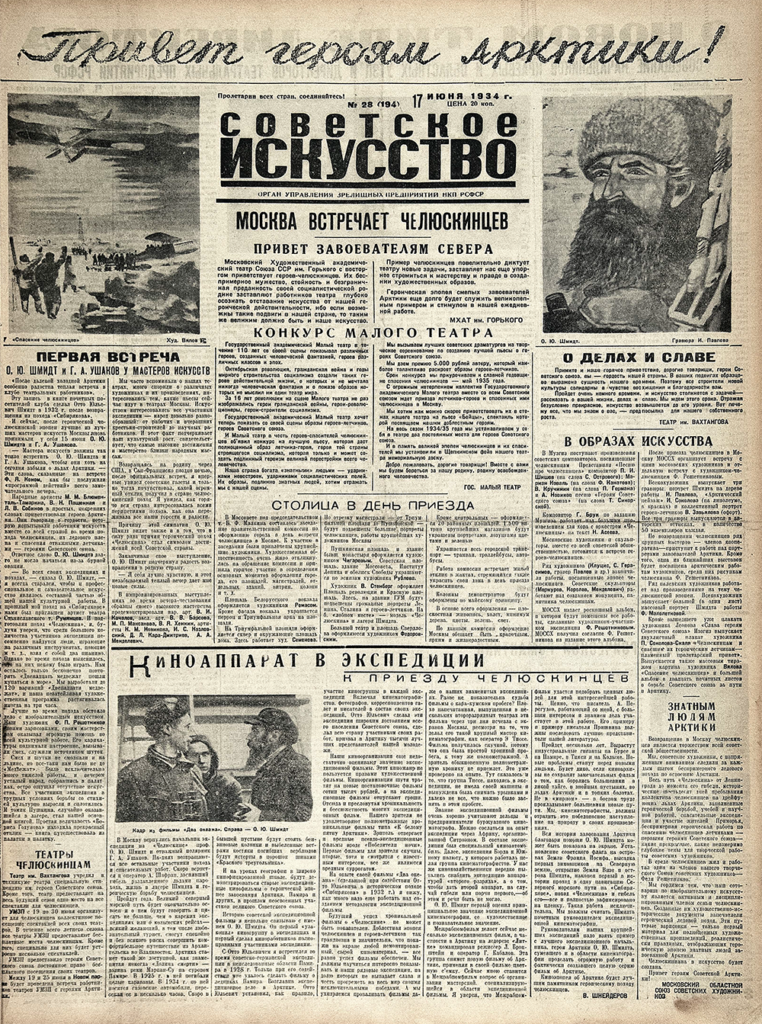
Kul’tura was previously published as Rabochii i iskusstvo (Рабочий и искусство, Workers and Art, 1929–1930), Sovetskoe iskusstvo (Советское искусство, Soviet Art, 1931–1941), Literatura i iskusstvo (Литература и искусство, Literature and Art, 1942–1944), Sovetskoe iskusstvo (1944–1953), and Sovetskaia kul’tura (Советская культура, Soviet Culture, 1953–1991).
The Sovetskaia Kul’tura Digital Archive contains all obtainable published issues from all of these titles (1929 on, over 55,000 pages), with an additional year’s worth of content available for purchase on an annual basis. The Sovetskaia Kul’tura Digital Archive offers scholars the most comprehensive collection available for this title, and features full page-level digitization, complete original graphics, and searchable text, and is cross-searchable with numerous other Infoteka digital resources.
Rabochii i iskusstvo was established during a time when artists had relative freedom to create works for the New Soviet man. Artists were enthusiastic in spreading the socialist revolution, and the newspaper at this time reflects that mindset. Art was to be made accessible to the masses. Whether explicitly or implicitly, the newspaper supported writers, artists, and authors who produced works that fostered the concept of the New Soviet Man.
During the Stalin years, Socialist realism took hold. Any creative expression considered unworthy to support the goals of socialism and communism was banned. Writers such as Mikhail Zoshchenko, Osip Mandelstam, Boris Pasternak, and others were roundly criticized in the pages of Sovetskoe iskusstvo (1931–1941), Literatura i iskusstvo (1942–1944), and Sovetskoe iskusstvo (1944–1952).
Sovetskaia kul’tura, established in 1953, came about in the thaw of the Khrushchev era. The times changed for the better, but the newspaper still toed the party line. Modern art exhibitions were condemned and avant-garde composers and abstract painters were censured.
During the Gorbachev era, glasnost created a cultural reawakening, which was reflected in the pages of Sovetskaia kul’tura. For example, the newspaper was the first to report that authorities had rehabilitated Pasternak posthumously and a museum dedicated to the work of Marc Chagall was to open in Belarus.
Today, the newspaper offers interesting reviews and event listings, often focusing on the cultural life of Moscow and the regions. It is also known for its topical commentaries on popular culture and politics.