
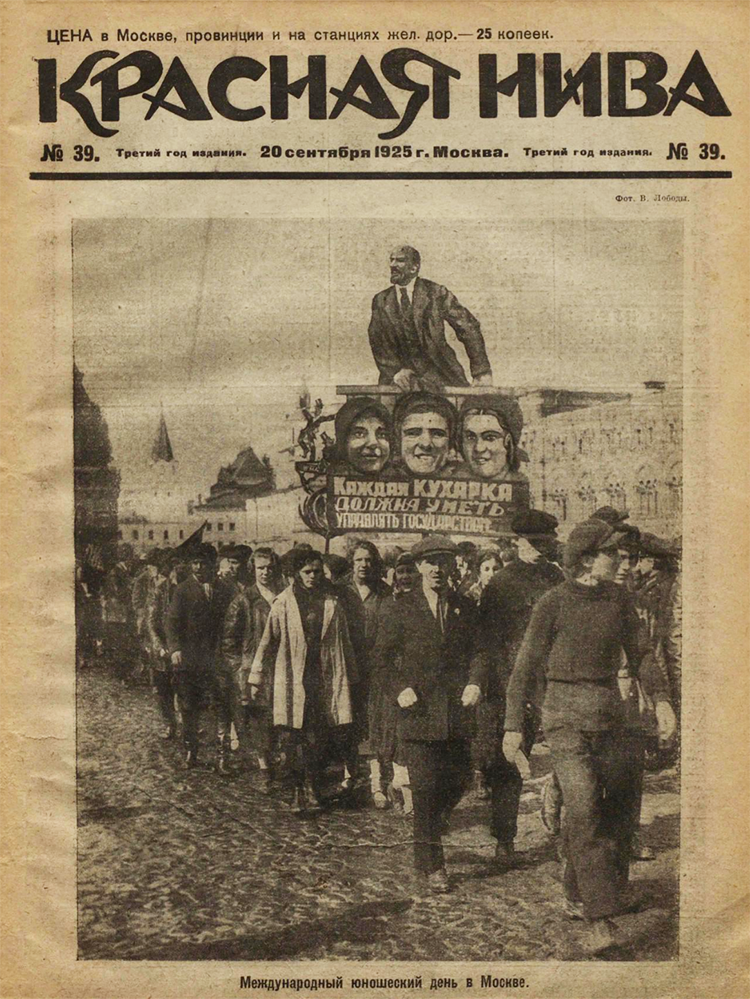
One of the most significant illustrated literary and cultural journals of the early Soviet period.
Published in Moscow from 1923 to 1931 as a supplement to Izvestiia, Krasnaia Niva (Красная нива, The Red Field) was conceived as a Soviet successor to the famous pre-revolutionary illustrated weekly Niva. Like its predecessor, it was designed for a broad reading public and combined literature, poetry, essays, popular science, cultural commentary, criticism, biography, current affairs, and abundant visual material.
Appearing during the formative decade between the end of the Civil War and the consolidation of Stalinist cultural policy, Krasnaia Niva offers an unusually rich record of Soviet intellectual and artistic life before the full standardization of Socialist Realism and the later mechanisms of cultural control. Its pages preserve the pluralism, contradictions, and experimentation of the 1920s: revolutionary rhetoric coexists with literary variety, popular education, internationalism, peasant themes, technological enthusiasm, satire, and visual modernism.
Krasnaia Niva published fiction and poetry by major and now-canonical writers, including Aleksandr Grin, Boris Pilniak, Mikhail Prishvin, Andrei Platonov, Vladimir Mayakovsky, Sergei Esenin, and others. It also featured translated literature by such international authors as Henri Barbusse, Romain Rolland, and O. Henry, reflecting the early Soviet effort to situate Russian readers within a global literary and political culture. Because some of its contributors later became politically suspect, marginalized, censored, or retrospectively rewritten out of Soviet literary history, the archive is especially valuable for reconstructing the cultural openness and instability of the 1920s.
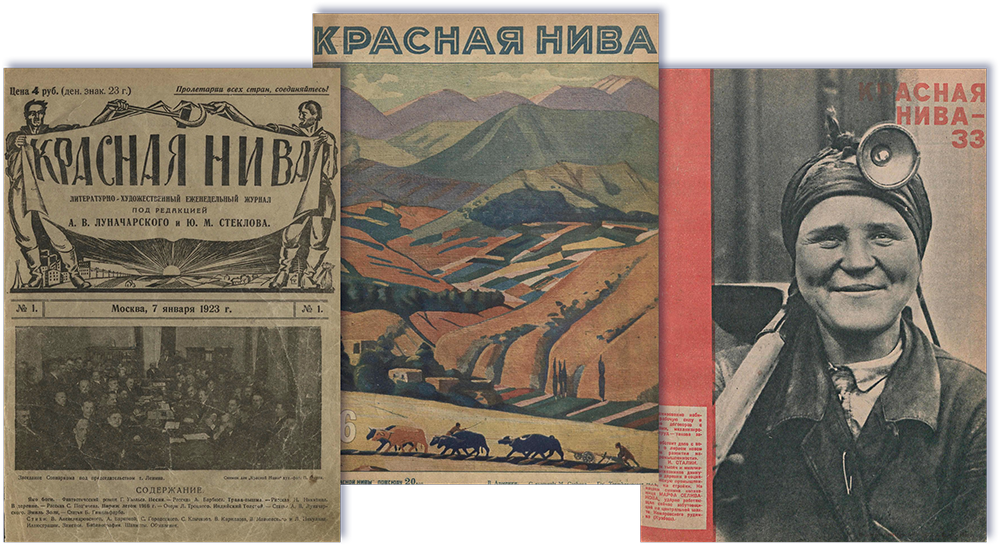
As an illustrated magazine, Krasnaia Niva is also an important source for the study of Soviet visual culture. Its pages feature reproductions of artworks, drawings, caricatures, decorative layouts, and striking cover designs that trace the changing graphic language of the early Soviet period—from post-revolutionary illustration and political satire to photomontage, Constructivist design, and the increasingly monumental imagery of socialist construction.
The journal’s visual significance is underscored by the fact that MoMA in New York holds Krasnaia Niva, no. 45, 1929, designed by Valentina Kulagina, as a letterpress-printed journal with a lithographed cover, associated with the Merrill C. Berman Collection of modern graphic material.
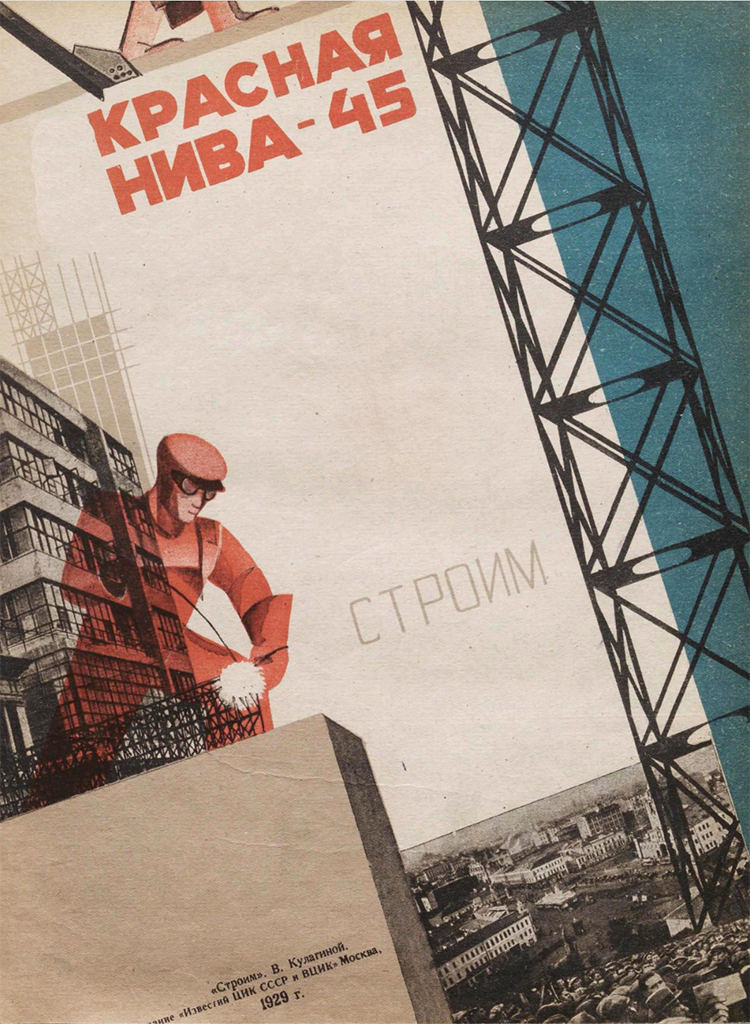
Krasnaia Niva, no. 45, 1929
The Krasnaia Niva Digital Archive is particularly valuable for scholars and students working in Slavic studies, Soviet history, Russian literature, art history, visual culture, media studies, book history, comparative literature, translation studies, and the history of popular science. It supports research into the New Economic Policy period, Soviet readership and mass culture, the transformation of the illustrated press, debates over “fellow travelers” and proletarian literature, representations of peasants and workers, the emergence of the “new Soviet everyday life,” and the gradual narrowing of cultural expression under ideological pressure.
The Krasnaia Niva Digital Archive offers scholars the most comprehensive collection available for this title. It includes fully searchable scans of every issue, preserving the visual and textual richness of the original print editions, and is cross-searchable with numerous other Infoteka digital resources. By making the full run searchable and accessible in digital form, the archive allows researchers to move beyond isolated famous texts or individual issues and instead trace themes, authors, images, genres, and ideological vocabulary across nearly a decade of Soviet cultural development. It is an essential primary-source archive for understanding how early Soviet culture was presented to a mass readership.
- Product Code: DA-KNIV
- Year First Published: 1923
- Archive: 1923–1931
- Language: Russian
- Country: Russia
- City: Moscow
- Frequency: Weekly
- Format: PDF, page-based
- Producer: Infoteka